AVIATION ENGINEERING PROGRAMME (ADMISSION CODE: TE3)
- Wednesday - 11/11/2026 16:23
- Close page
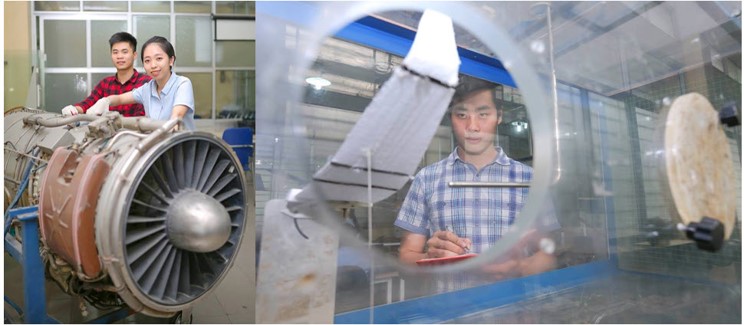
Aviation Engineering Programme Specification:
- Before K70: Download Here
- From K70: Download Here
| Degree | Duration | Total credits | Field |
| Bachelor in Aviation Engineering | 4 years | 132 credits | Aviation Engineering |
1. Programme Overview and Educational Objectives
Aviation plays an essential role in passenger and freight transport, national security, economic development, and international connectivity. Hanoi University of Science and Technology has a long tradition of educating aviation professionals who contribute to airlines, airports, maintenance organisations, engineering companies, research institutes, and public agencies.
The Bachelor in Aviation Engineering programme develops high-quality graduates for the domestic and international labour markets. The curriculum combines mathematics and basic sciences, core mechanical engineering, aviation engineering, digital technologies, professional practice, communication, teamwork, ethics, innovation, and research.
2. Upon graduation, students are expected to be able to:
- Apply fundamental knowledge of natural sciences, social sciences, economics and politics to solve fundamental problems in the field of Aerospace Engineering.
- Analyze engineering problems in the field of Aerospace Engineering by applying foundational engineering knowledge.
- Design components, equipment and basic systems in the field of Aerospace Engineering to meet engineering and practical requirements.
- Develop appropriate engineering solutions for components, mechanical systems and basic automation systems in the field of Aerospace Engineering.
- Effectively use machines, equipment, systems, processes and specialized software in the field of Aerospace Engineering.
- Integrate analytical and problem-solving skills effectively to address fundamental issues in the field of Aerospace Engineering.
- Work effectively in a team, scientific thinking to accomplish tasks in leadership roles or as team members.
- Communicate effectively verbal, written and multimedia communication skills in social and professional contexts using Vietnamese and English
- Demonstrate professional ethics, responsibility and comply with legal regulations and industry standards in Aerospace Engineering.
- Develop a clear career orientation and maintain a lifelong learning mindset to adapt to advances in science and technology.
- Apply critical thinking, creativity and innovation in analyzing and solving Aerospace Engineering problems.
- Design and implement basic research projects in the field of Aerospace Engineering
3. Student Learning Experience
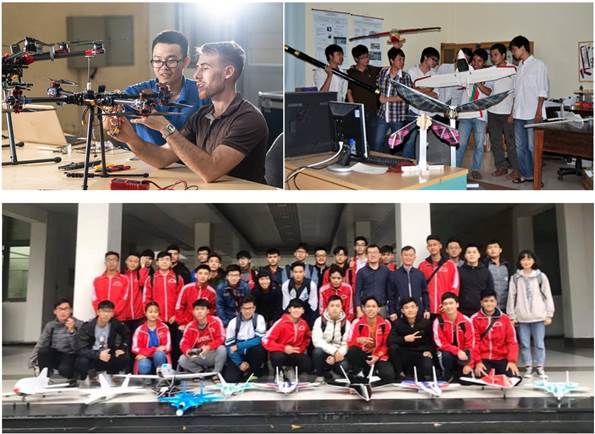
Students learn through lectures, tutorials, laboratory work, engineering design projects, team assignments, presentations, industry-related case studies, engineering practicum, and a bachelor thesis.
- opportunities for engineering practicum and professional exposure at aviation-related companies and organisations;
- participation in aircraft modelling, unmanned aerial vehicle, design, simulation, and student research activities under academic supervision;
- access to academic advising, career guidance, alumni support, and information on employment and postgraduate study;
- opportunities to join academic competitions, seminars, company visits, and collaborative projects;
- access to university, school, alumni, research-group, and partner scholarships, subject to the conditions announced each year.
4. Career Opportunities
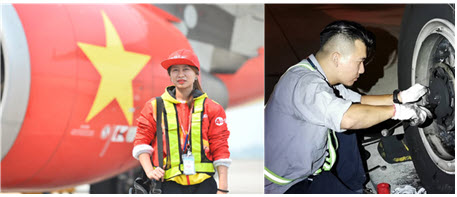
Graduates are prepared for technical, operational, design, maintenance, research, and management-related roles in the aviation sector and in closely related mechanical and industrial engineering fields.
- aircraft inspection, maintenance, repair, and overhaul organisations;
- airlines, airports, airport service companies, and aviation technical service providers;
- engineering design, manufacturing, production, operation, and quality-control departments;
- companies working in aircraft systems, propulsion, structures, aerodynamics, materials, automation, and unmanned aerial vehicles;
- research and development institutes, universities, laboratories, and technology companies;
- postgraduate education and professional development in aviation, aerospace, mechanical, transport, and related engineering disciplines.
5. Programme Structure
The Bachelor programme is normally completed in four years and requires 132 credits. Its main components are:
- General Education: 45 credits, including mathematics, basic sciences, law, political education, and English requirements;
- Professional Education: 87 credits, including basic and core engineering, supporting skills, aviation-oriented electives, engineering practicum, and the bachelor thesis;
- Aviation-oriented study areas including aerodynamics, aircraft structures, aircraft propulsion, aircraft systems, aviation materials, aviation regulations, inspection and maintenance, flight mechanics, aircraft electrical and electronic engineering, numerical methods, and aircraft design projects.
Students who meet the relevant admission and academic requirements may pursue further study through postgraduate programmes offered by HUST or other institutions.
6. Programme Contact
| Name | Advisory email | Telephone |
| Assoc. Prof. Dr. Le Thi Tuyet Nhung | Nhung.lethituyet@hust.edu.vn | 0909067299 |
Note: Scholarship schemes, admissions information, contact details, and programme implementation arrangements should be updated on the website whenever new official announcements are issued.