Standard Programmes
- Friday - 31/07/2026 09:41
- Close page
These are long-established programmes that have been continuously improved for more than 30 years. The School of Mechanical Engineering currently offers six standard programmes.
| No. | Department | Major | Programme (Click the programme name for details) |
| 1 | Mechanical and Manufacturing Engineering | Mechanical Engineering | Mechanical Engineering |
| 2 | Mechatronics | Mechatronics Engineering | Mechatronics Engineering |
| 3 | Vehicle and Energy Conversion Engineering | Transport Mechanical Engineering | Transport Mechanical Engineering |
| 4 | Automotive Engineering | Automotive Engineering | |
| 5 | Aviation Engineering | Aviation Engineering | |
| 6 | Thermal Energy Engineering | Thermal Engineering | Thermal Engineering |
The initial training program for students admitted to the School of Mechanical Engineering:
1. Mechanical Engineering Bachelor’s Program
The Mechanical Engineering group has 05 fields of application:
- Manufacturing Engineering
- Forming and Deformation process
- Welding Technology
- Precision and Optical
- Plastic and Composite Technology
The content of the training program is shown in the following diagram:
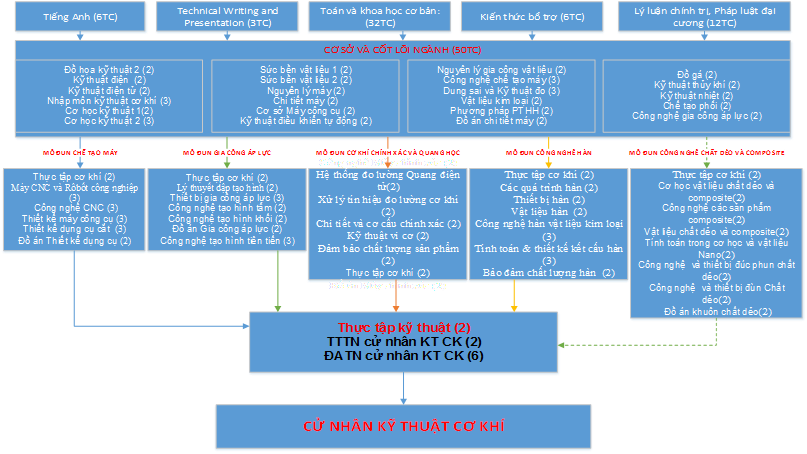
Mechanical Engineering Bachelor’s Program
The enrollment quota and admission number of recent years are described as following:
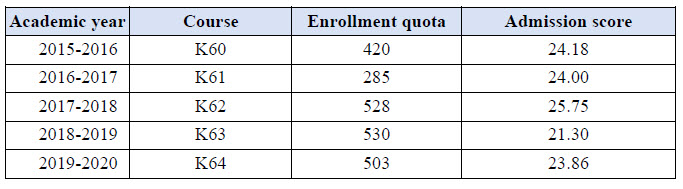
Enrollment quota and admission scores for ME program
The development of output standards from which to adjust the training program so that it is close to these requirements is a very important task of the School and the University in recent years. Learners who are interested in the output standards, as well as the training programs of the systems, can refer to the details below.
Output Standards and Training programs (Click the link to view):
- Output standards of the Bachelor of Mechanical Engineering Program (4 years)
- Output standards of the Bachelor-Master Integrated Program in Mechanical Engineering.pdf (5,5 years)
- Output standards of the Integrated Program of Bachelor-Engineer in Mechanical Engineering (5,5 years)
Detailed training program (Click the link to view):
- Training program of Bachelor Program in Mechanical Engineering (4 years)
- The training program of the Integrated Program of Bachelor-Engineer in Mechanical Engineering (5,5 years)
- The training program of the Mechanical Engineering Engineer Program (5 years)
2. Bachelor of Mechatronics Engineering
The Mechatronics Engineering group has 04 fields of application:
- Automatic Manufacturing System
- Automatic Equipment
- Robot
- Intelligent Mechatronics System
The content of the training program is shown in the following diagram:
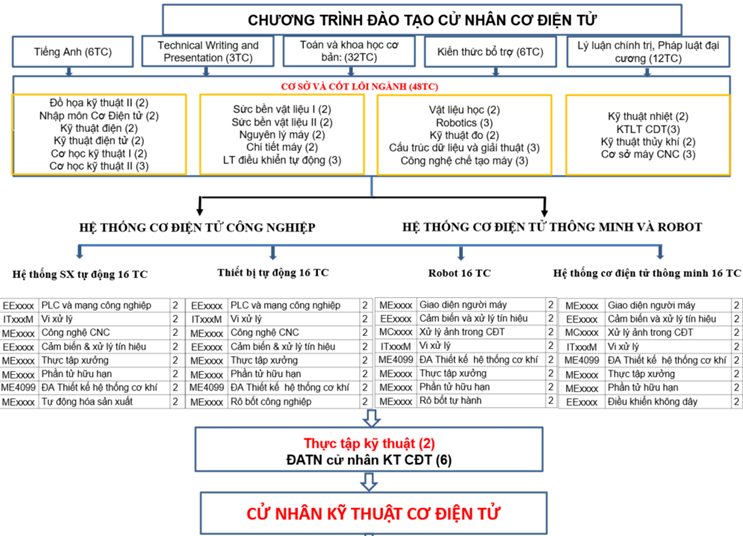
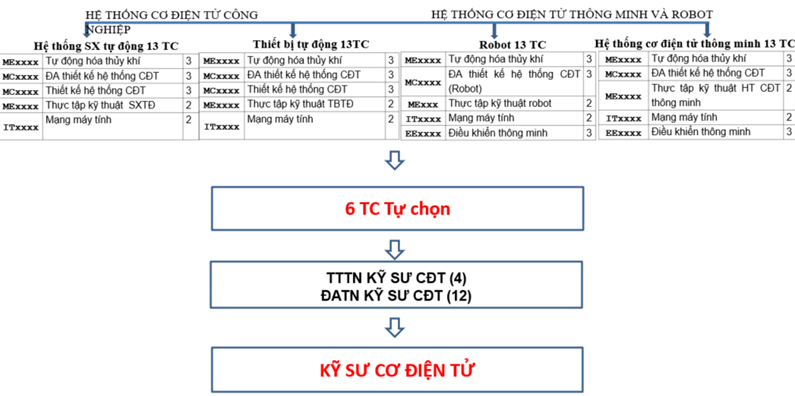
Mechatronics Engineering Bachelor’s Program
Output Standards and Training programs (Click the link to view):
- Objectives and Output Standards of the Bachelor of Mechatronic Engineering Program (4 years)
- Objectives and Output Standards of the Bachelor of Mechatronic Technology Program (4 years)
- Objectives and Output Standards of the Integrated Program of Bachelor-Engineer in Mechatronic Engineering (5 years)
- Objectives and Output Standards of the Mechatronics Engineering Program (5 years)
Detailed training program (Click the link to view):
- Training program of Bachelor Program in Mechatronic Engineering (4 years)
- Training Program of the Integrated Program Bachelor-Engineer in Mechatronic Engineering (5 years)
- The training program of the Mechatronics Engineering Program (5 years)
3. Bachelor of Automative Engineering
The Automotive Engineering program includes 47 credits of foundation and core courses, grounded in basic mechanical engineering theory and fundamental automotive engineering knowledge (such as general automotive structure and power sources in vehicles), along with extensive practical assignments. Learners are equipped to apply this core industry knowledge and utilize modern methods and tools to design and evaluate solutions for systems, processes, and products in mechanical engineering in general, and automotive engineering applications in particular.
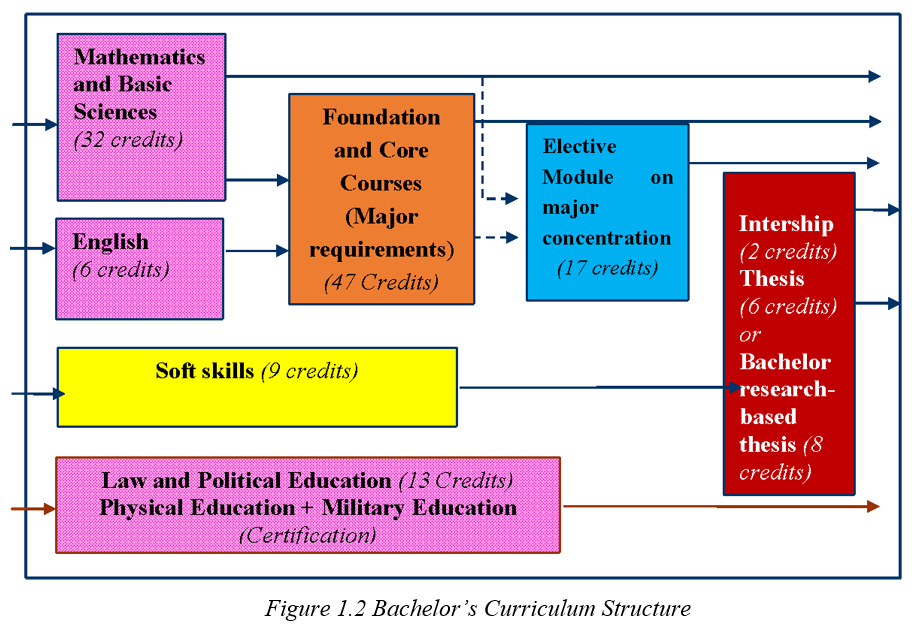
Detailed training program (Click the link to view):
4. Bachelor in Transport Mechanical Engineering
The undergraduate programme in Transport Mechanical Engineering (TME) is one of five undergraduate programmes at Department of Vehicle and Energy Conversion Engineering (VECE), School of Mechanical Engineering (SME). The TME programme has been developed since 2007 and applied since 2009. General information about the TME training programme is shown in table below.
| Education level: | Bachelor |
| Major: | Transport Mechanical Engineering |
| Training Code: | 7520116 |
| Duration: | 4 years |
| Degree: | Bachelor in Transport Mechanical Engineering |
| Credits in total: | 132 credits |
The TME programme is built with two specified orientational modules: Fluid Power and Automation Engineering (FPAE) module and Intelligent Water Vehicle Engineering (IWVE) module. FPAE module focuses on the problems of machines & automation systems using fluid power sources and renewable energy machines such as wind turbines, water turbines and tidal turbines,… IWVE module focuses on the problems of water vehicles and smart water vehicles such as: modern ships, offshore structures such as oil and gas rigs, autonomous systems and equipment, automation equipment controlling marine energy exploitation systems, modern ships. The TME programme provides learners with the knowledge and skills necessary to become competent experts in research, calculation, design, manufacturing and operation of fluid machines & automation, vehicles and systems in most fields of transport mechanical engineering meeting the needs of society and the country. The TME programme is designed in accordance with the form of a credit-based training system. The training model of the TME programme is based on the new university model proposed in 2020 as shown in Figure 01. The TME programme requires 4 years (8 semesters) for a bachelor degree, including 132 credits, divided into two large blocks: general education block (51 credits) and professional education block (81 credits). In professional education block, there are 46 credits for basic and core of engineering, 9 credits of soft skills, 18 credits for elective modules, 8 credits for bachelor project and including the internship. After the bachelor program, students can continue to study for a master’s or engineering degree by accumulating an additional 48 credits in one and a half years (Figure 02). All courses and study plan of the program are shown in Figure 03.
5. AVIATION ENGINEERING PROGRAMME
| Degree | Duration | Total credits | Field |
| Bachelor in Aviation Engineering | 4 years | 132 credits | Aviation Engineering |
Aviation Engineering Programme Specification: Download Here
5.1. Programme Overview and Educational Objectives
Aviation plays an essential role in passenger and freight transport, national security, economic development, and international connectivity. Hanoi University of Science and Technology has a long tradition of educating aviation professionals who contribute to airlines, airports, maintenance organisations, engineering companies, research institutes, and public agencies.
The Bachelor in Aviation Engineering programme develops high-quality graduates for the domestic and international labour markets. The curriculum combines mathematics and basic sciences, core mechanical engineering, aviation engineering, digital technologies, professional practice, communication, teamwork, ethics, innovation, and research.
5.2. Upon graduation, students are expected to be able to:
Apply fundamental knowledge of natural sciences, social sciences, economics and politics to solve fundamental problems in the field of Aerospace Engineering.
Analyze engineering problems in the field of Aerospace Engineering by applying foundational engineering knowledge.
Design components, equipment and basic systems in the field of Aerospace Engineering to meet engineering and practical requirements.
Develop appropriate engineering solutions for components, mechanical systems and basic automation systems in the field of Aerospace Engineering.
Effectively use machines, equipment, systems, processes and specialized software in the field of Aerospace Engineering.
Integrate analytical and problem-solving skills effectively to address fundamental issues in the field of Aerospace Engineering.
Work effectively in a team, scientific thinking to accomplish tasks in leadership roles or as team members.
Communicate effectively verbal, written and multimedia communication skills in social and professional contexts using Vietnamese and English
Demonstrate professional ethics, responsibility and comply with legal regulations and industry standards in Aerospace Engineering.
Develop a clear career orientation and maintain a lifelong learning mindset to adapt to advances in science and technology.
Apply critical thinking, creativity and innovation in analyzing and solving Aerospace Engineering problems.
Design and implement basic research projects in the field of Aerospace Engineering
5.3. Student Learning Experience
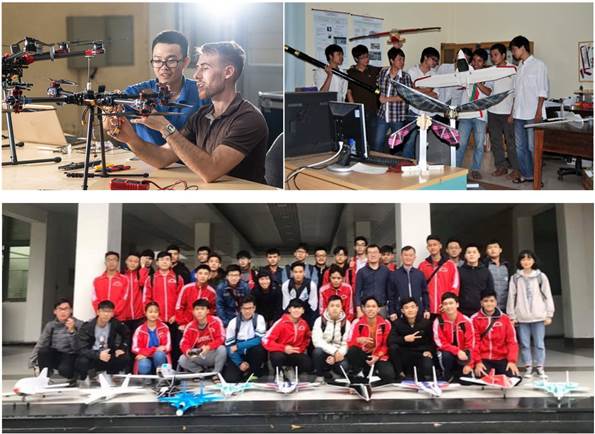
Students learn through lectures, tutorials, laboratory work, engineering design projects, team assignments, presentations, industry-related case studies, engineering practicum, and a bachelor thesis.
Opportunities for engineering practicum and professional exposure at aviation-related companies and organisations;
Participation in aircraft modelling, unmanned aerial vehicle, design, simulation, and student research activities under academic supervision;
Access to academic advising, career guidance, alumni support, and information on employment and postgraduate study;
Opportunities to join academic competitions, seminars, company visits, and collaborative projects;
Access to university, school, alumni, research-group, and partner scholarships, subject to the conditions announced each year.
5.4. Career Opportunities
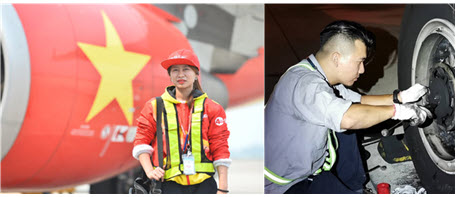
Graduates are prepared for technical, operational, design, maintenance, research, and management-related roles in the aviation sector and in closely related mechanical and industrial engineering fields.
Aircraft inspection, maintenance, repair, and overhaul organisations;
Airlines, airports, airport service companies, and aviation technical service providers;
Engineering design, manufacturing, production, operation, and quality-control departments;
Companies working in aircraft systems, propulsion, structures, aerodynamics, materials, automation, and unmanned aerial vehicles;
Research and development institutes, universities, laboratories, and technology companies;
Postgraduate education and professional development in aviation, aerospace, mechanical, transport, and related engineering disciplines.
5.5. Programme Structure
The Bachelor programme is normally completed in four years and requires 132 credits. Its main components are:
- General Education: 45 credits, including mathematics, basic sciences, law, political education, and English requirements;
- Professional Education: 87 credits, including basic and core engineering, supporting skills, aviation-oriented electives, engineering practicum, and the bachelor thesis;
- Aviation-oriented study areas including aerodynamics, aircraft structures, aircraft propulsion, aircraft systems, aviation materials, aviation regulations, inspection and maintenance, flight mechanics, aircraft electrical and electronic engineering, numerical methods, and aircraft design projects.
Students who meet the relevant admission and academic requirements may pursue further study through postgraduate programmes offered by HUST or other institutions.
5.6. Programme Contact
| Name | Advisory email | Telephone |
| Assoc. Prof. Dr. Le Thi Tuyet Nhung | Nhung.lethituyet@hust.edu.vn |