TRƯỜNG CƠ KHÍ - Đại học Bách khoa Hà Nội
Trường Cơ khí - Đại học Bách khoa Hà Nội
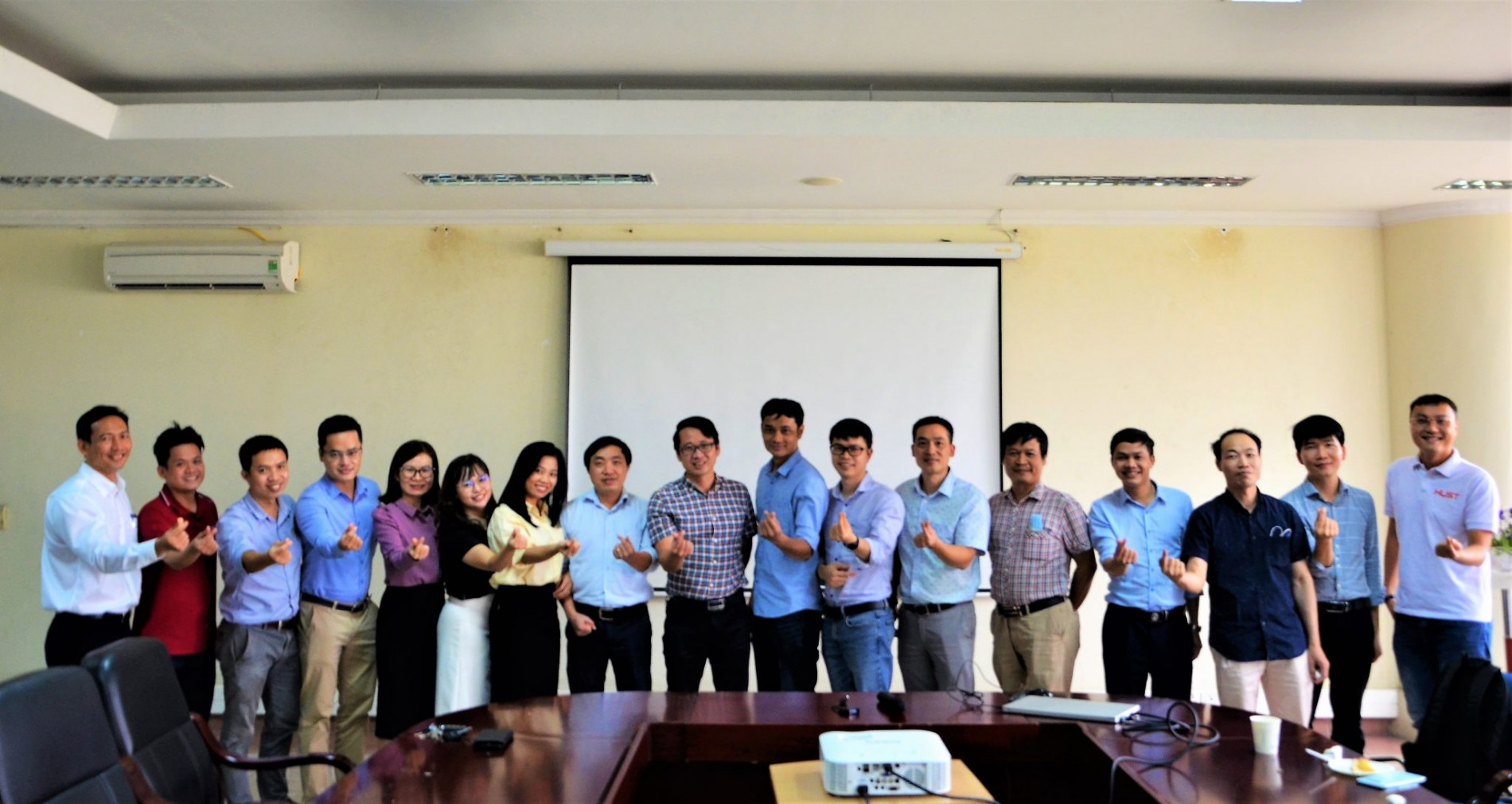
Trường Cơ khí được thành lập với sự liên kết của ba Viện: Viện Cơ khí, Viện Cơ khí Động lực, Viện khoa học và công nghệ Nhiệt lạnh. Với mục tiêu gắn kết các đơn vị trong Trường cũng như tạo điều kiện cho các cán bộ được giao lưu, chia sẻ cũng như trình bày các hướng nghiên cứu và các thành tích nổi bật trong nghiên cứu khoa học, Trường Cơ khí đã tổ chức buổi sinh hoạt nghiên cứu học thuật vào tháng 10/2022.
Hội nghị diễn ra với sự hiện diện của PGS. TS Trương Hoành Sơn – Hiệu trưởng Trường Cơ Khí, PGS. TS Phạm Văn Sáng – Phó Hiệu trưởng Trường Cơ khí, PGS. TS Vũ Toàn Thắng – Trưởng Khoa Cơ Điện tử, cùng nhiều thầy cô trong Trường.
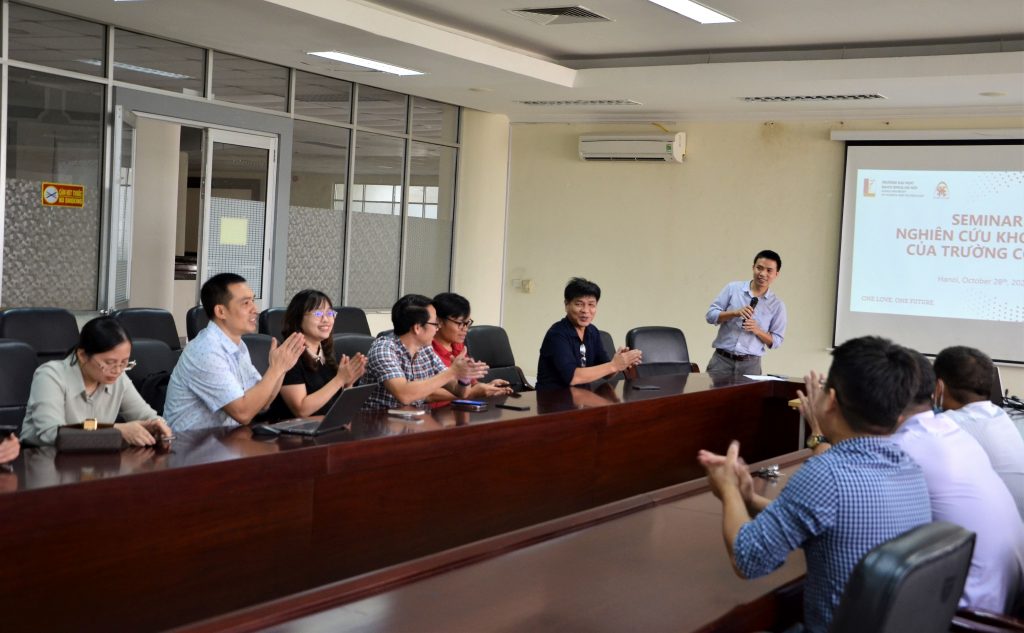
Hội nghị nghiên cứu Khoa học tháng 10 – Trường Cơ khí. Ảnh NHT
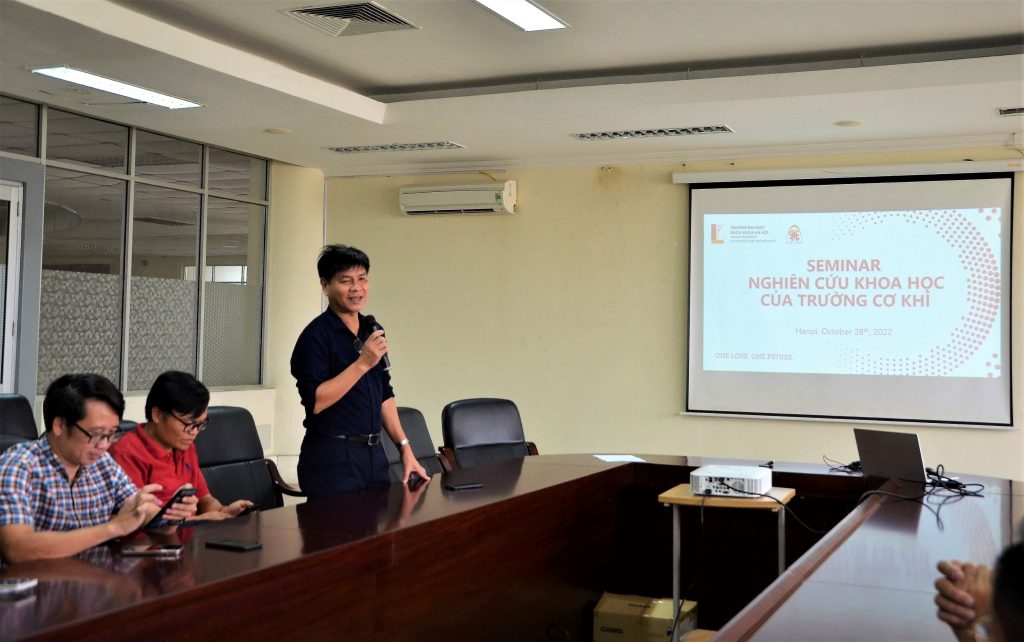
PGS. Trương Hoành Sơn phát biểu tại hội nghị. Ảnh NHT
Hội nghị Nghiên cứu Khoa học tháng 10 lần này bao gồm hai báo cáo:
Báo cáo viên: TS. Nguyễn Thanh Tuấn – Khoa Cơ khí Chế tạo máy
| Abstract: Failure of any engineering structures such as leakage and explosion, especially structural components in energy production and transportation may cause seriously economic losses and risks to human life. It has been reported that the major problems occurring in these structural components are often related to material degradation due to the influence of harsh environmental factors such as high temperature, high pressure, thermal radiation, and corrosion. The process of material degradation will be accompanied by the appearance of small cracks in the microstructure of the material. Moreover, the manufacturing processes can also create defects, both internally and on the surface of components. Stress concentration at these locations will lead to the formation of microcracks due to stress concentration exceeding the strength limit of the material. Continuing to use a structural component with a defect crack may present a large hazard risk and is cause for concern since these microcracks can easily develop into uncontrollable cracks, causing sudden destructions. The situation can become more serious under a synergistic effect between the severe stress conditions and harsh environmental factors. Therefore, the proactive understanding of environmental assisted failures through experimental works is important for the life prediction of structural components and should be carefully considered for safe design and operation. Assessment of the remaining life of a component containing a defect is necessary to ensure that the material is eligible for service under current standards. |
Báo cáo viên TS. Trần Văn Quốc – Khoa Cơ Điện tử
| Abstract: In the past few decades, researchers across different scientific and engineering communities, including biology, sociology, combinatorics, economics, and control and systems, have put tremendous effort into exploring the underlying mechanisms leading to complex collective behaviors in networked dynamic systems. Typical examples of networked systems consist of flock of birds and school of fish, wireless sensor networks, multirobot systems, and evolution networks of COVID-19. The control systems community particularly focuses on modeling networked multi agent systems, and designing control protocols for the individual robotic agents so that a group-task is achievable. Among those, formation control is a fundamental task, in which a fleet of agents aim to form a desired geometrical pattern by imposing certain geometric constraints between them. In this talk, several collective behaviors of animals in nature together with their network-based explanation will be presented. We will be able to see, based on mathematical tools, that the collective behavior of such a network is largely ruled by its underlying topological structure, i.e., how the agents interact with each other. As for an application, this presentation will address bearing-constrained formation tracking control of mobile agents under nonholonomic constraints. To wrap up the presentation, discussions on possible research directions are given |
Một số hình ảnh ấn tượng tại hội nghị Nghiên cứu Khoa học Tháng 10:
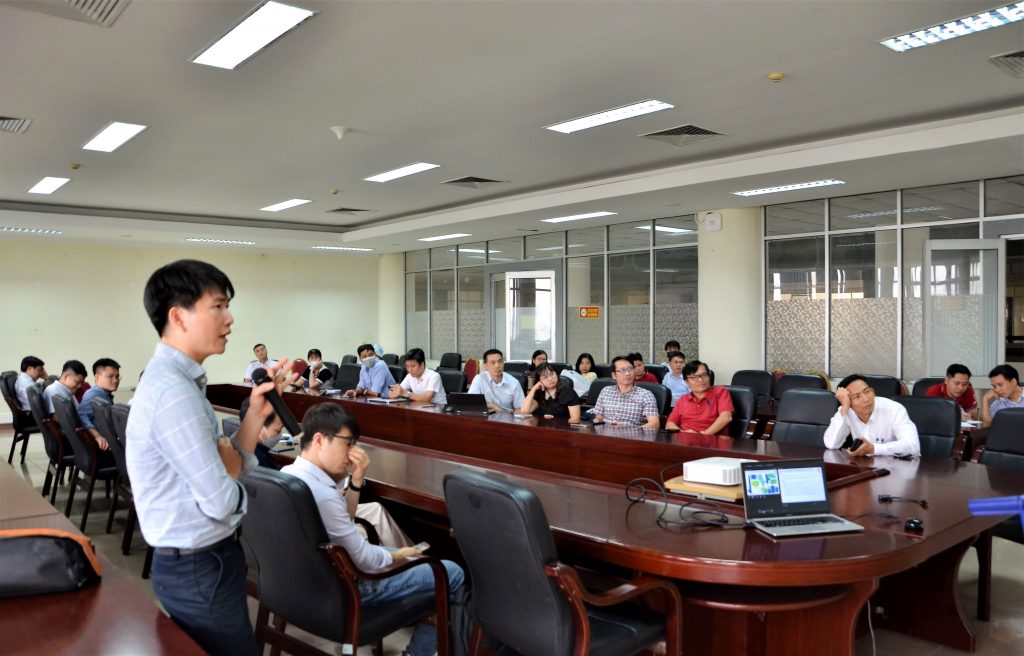
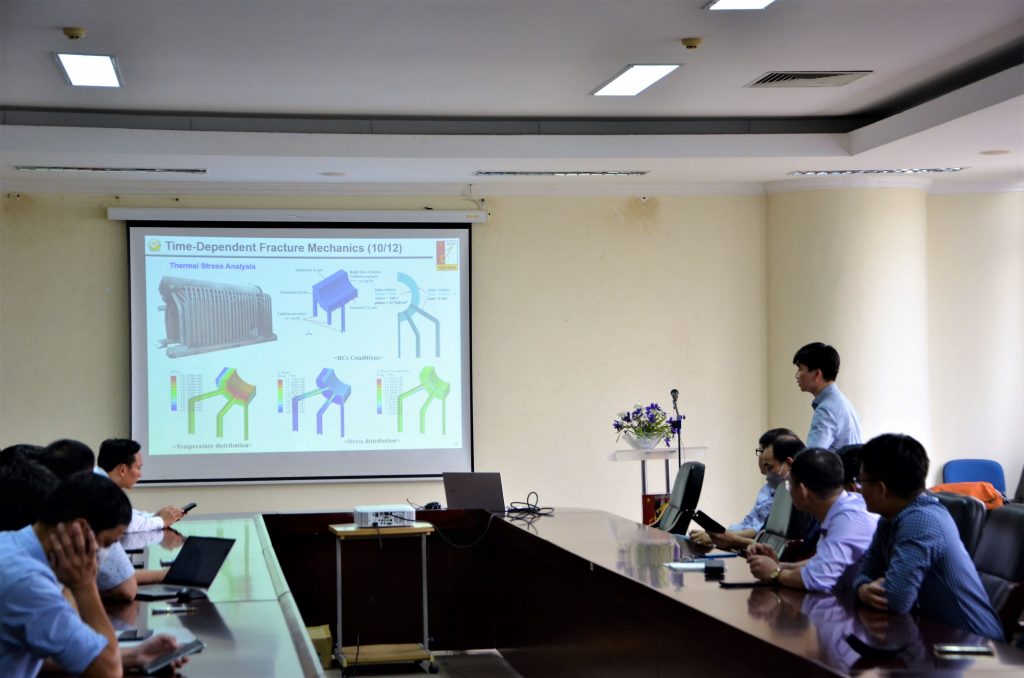
TS. Nguyễn Thanh Tuấn trình bày tại hội nghị. Ảnh NHT
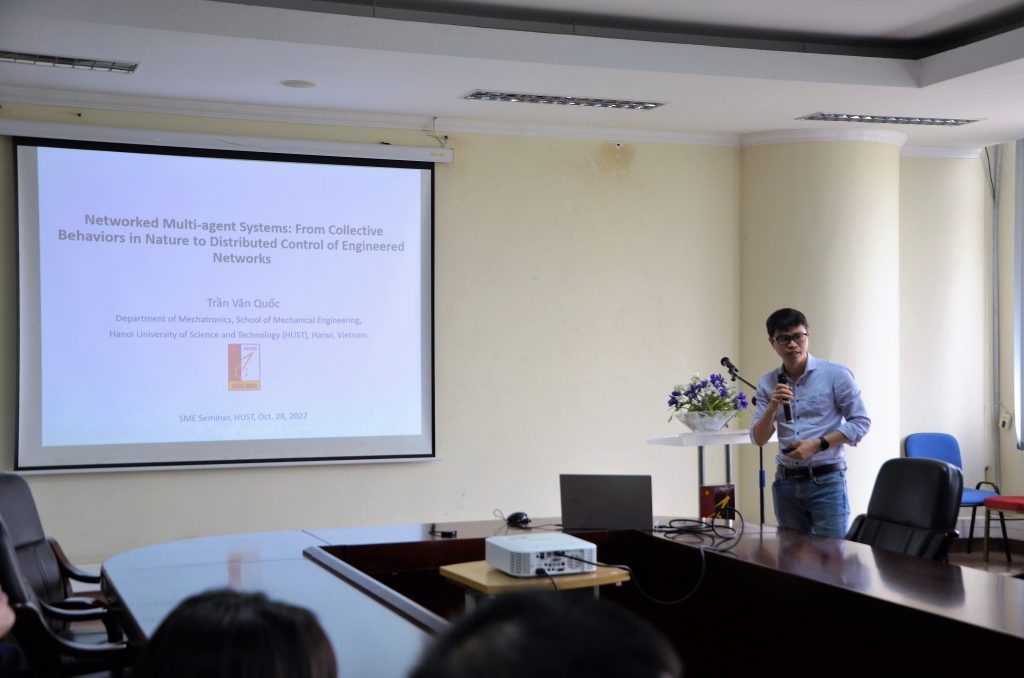
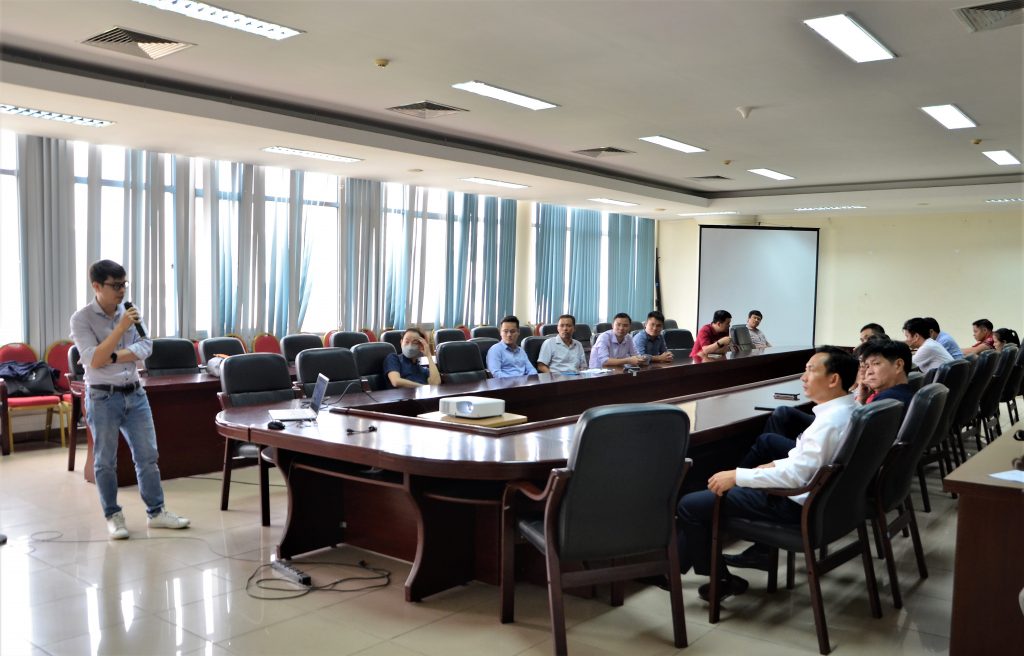
TS. Trần Văn Quốc trình bày tại hội nghị. Ảnh NHT
Những tin mới hơn
Những tin cũ hơn